
 English


 Published: January 27, 2026
 Editor: Ruoxi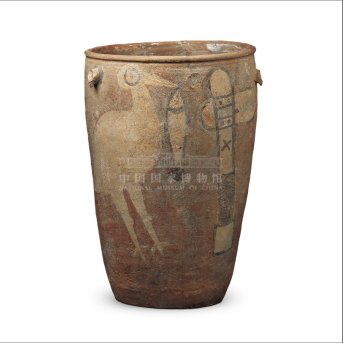
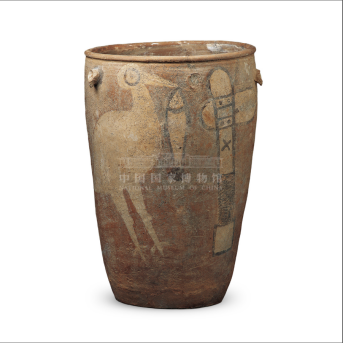
Early Neolithic Period, Yangshao Culture
Height: 47 cm, Mouth diameter: 32.7 cm, Base diameter: 20.1 cm
Unearthed in 1978 at Yan Village, Linru County (now Ruzhou City), Henan Province
This painted pottery jar has a red exterior and a straight-sided, flat-bottomed cylindrical form. On the outer wall is a painted scene: on the left stands a white stork, its body entirely white, with round eyes and a long beak, head held high, grasping a large fish in its beak. On the right stands a stone axe, pierced through the body, with woven material wrapped around the handle and incised symbols carved into it.
To convey the softness of the stork's white feathers, the artist covered the entire body of the bird in white pigment, resembling the later Chinese painting technique known as "boneless" (mogu) painting. The outlines of the stone axe and the fish are rendered using the "outline drawing" (gouxian) technique, defined by simple, fluent, bold lines. Color is then filled into the bodies of the axe and the fish, similar to the later Chinese painting method of color filling. Because this image already embodies several fundamental techniques of traditional Chinese painting, some scholars consider it a prototype of Chinese painting.