
 English


 Published: December 12, 2025
 Editor: Cao Xuewen,Yang Shuo
Gongcheng Oil Tea is a traditional food of the Yao people. In 2021, Tea Customs (Yao Oil Tea Customs) was added to the extended list of national intangible cultural heritage representative items. In 2022, China's traditional tea-processing techniques and associated social practices, including Tea Customs (Yao Oil Tea Customs), were inscribed on UNESCO's Representative List of the Intangible Cultural Heritage of Humanity.
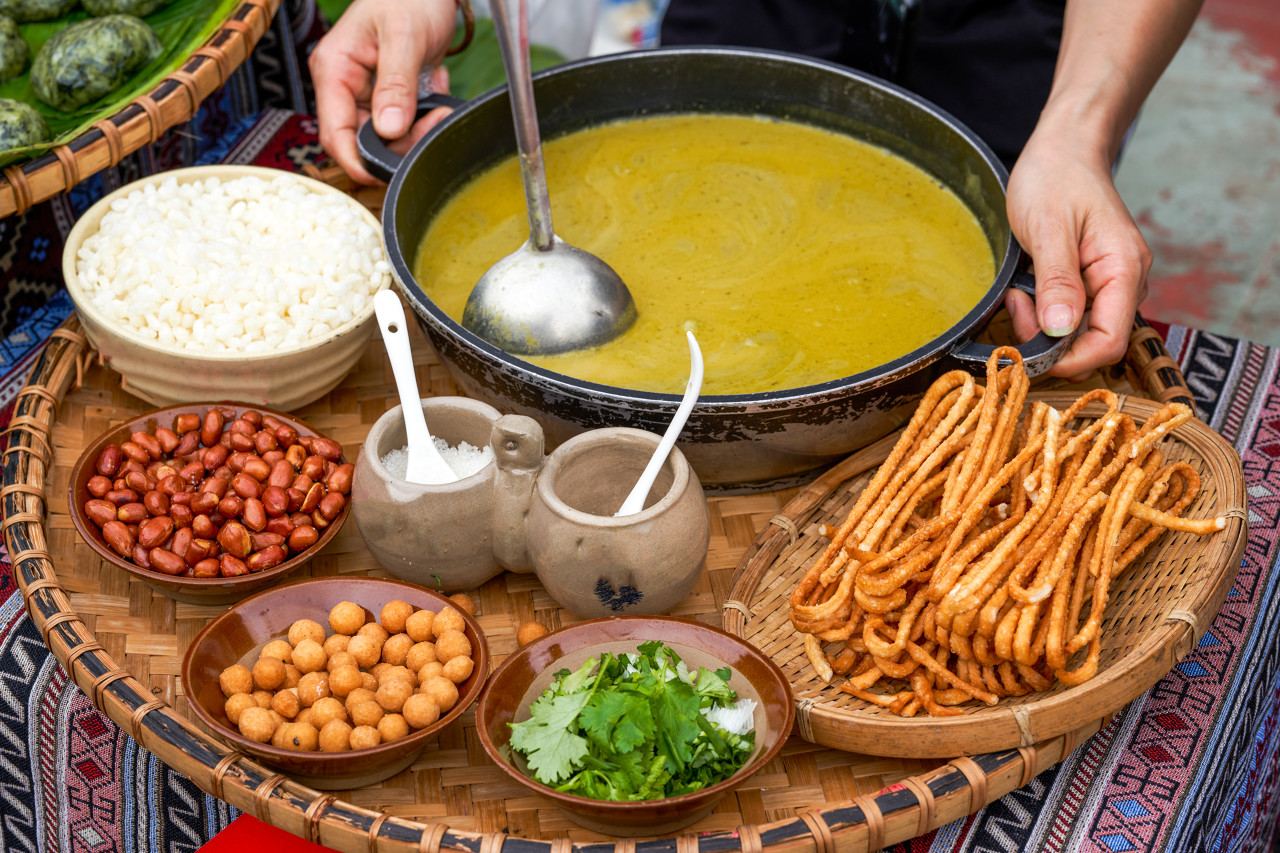
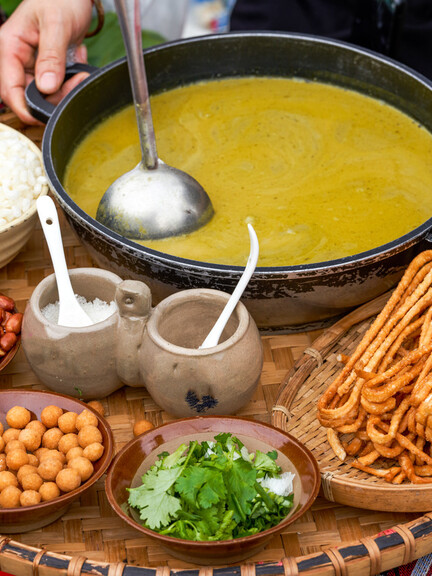
The preparation of authentic Gongcheng Oil Tea is exceptionally particular, using only locally sourced ingredients: tea leaves, ginger, and water, supplemented with garlic, peanuts, and oil. Three special tools are also required: a thick iron pan with a handle and a spout along the rim, a wooden oil-tea pestle shaped like the number "7," and a bamboo-woven tea strainer.
The soaked tea leaves are first placed in the iron pan and lightly stir-fried to evaporate excess moisture. Ginger, garlic, peanuts, and oil, each previously lightly smashed, are then added and fried together. Using the oil-tea pestle, the cook pounds out the juices of the ginger and garlic, crushes the peanuts, and grinds the tea leaves into fine shreds. Once the tea leaves are fully pounded, boiling water is poured into the pan, along with a pinch of salt. As the ingredients are blended with the hot water, the mixture assumes a yellowish-green hue. The tea strainer is then set over a teapot, filtering out the solids and leaving behind a clear, bright Oil Tea.
Freshly made Oil Tea is not served immediately. In Gongcheng, people say, "The first cup is bitter, the second cup is astringent, but the third and fourth cups make good Oil Tea." This means that the secret to good Oil Tea lies in blending batches of differing strengths. Even the solids caught in the tea strainer are treasured—they are repeatedly returned to the pan to extract every bit of flavor, refining the taste of the Oil Tea each time.