
 English


 Published: February 11, 2026
 Editor: Yang Shuo
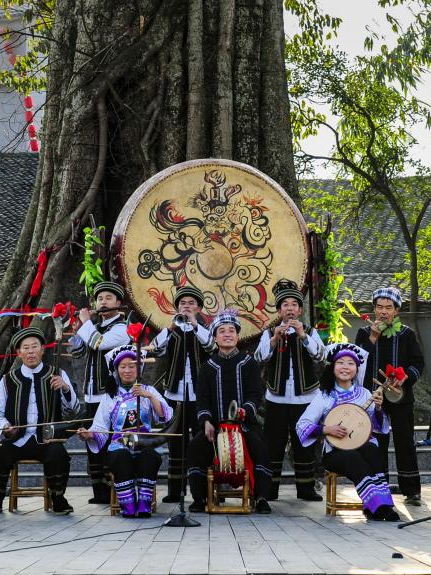
Bouyei Eight-Tone Sitting Singing, also known as "Bouyei Eight-Tone," is a form of folk narrative singing passed down through generations of the Bouyei ethnic group. For centuries, it has been preserved and practiced in villages throughout the Nanpan River basin and has been praised as "a peerless echo of the human world, music of heavenly beauty," "a living fossil of sound," and "an artistic pearl along the Nanpan River." The Bouyei Eight-Tone Ensemble of Xingyi City, Guizhou Province, has been invited on many occasions to perform both in China and abroad.
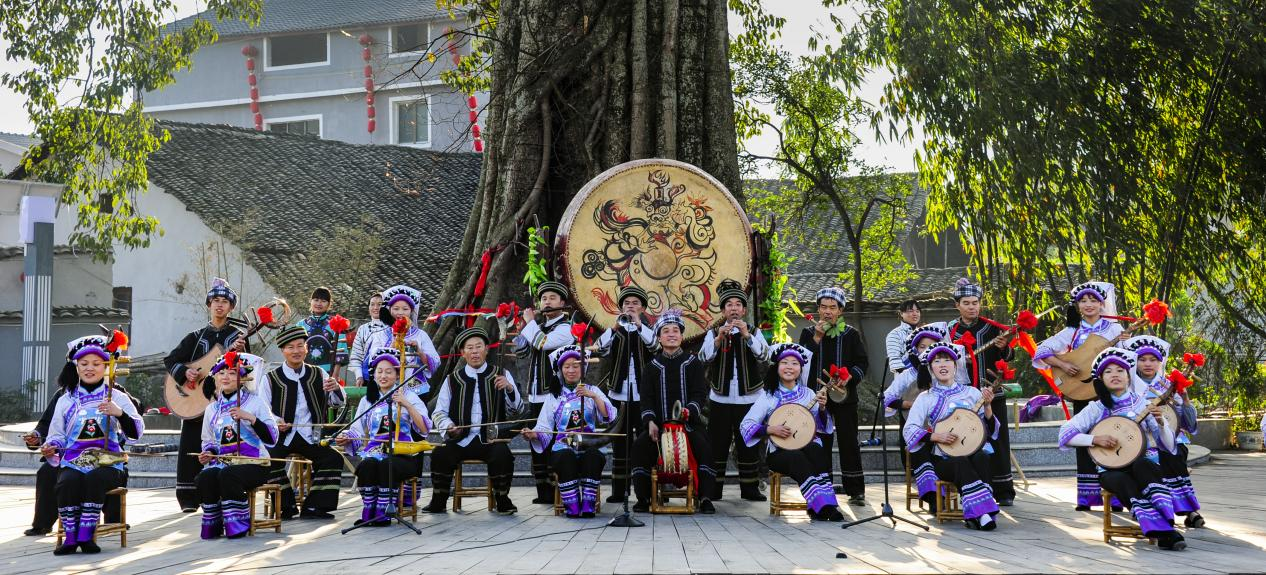
The performance takes the form of eight performers seated in a circle, each holding one of eight instruments, including the niu gu hu (ox-bone fiddle, also known as horn fiddle), hulusi (gourd lute), yueqin, ci gu (bamboo drum), xiao tong (tube flute), hairpin clappers, bao bao luo (gong), and xiao ma luo (gong). Storytelling is delivered through alternating modes: first-person narration that "jumps into" the story, and third-person narration that "steps out" to explain it. In some cases, additional ethnic instruments such as lelang, leyou, muye, and suona are incorporated for accompaniment. During singing, male performers typically sing an octave higher, while female performers sing in the original key. This creates a strong contrast in pitch and timbre and enhances the expressive appeal of the performance. Representative traditional pieces include Hexitang, Huxi and Nanxiang, Yingkediao, Fumantang, Jingjiuge, and Heshoutang.
Eight-Tone Sitting Singing was gradually created and refined by the Bouyei people through long-term production and daily life. Deeply rooted among the Bouyei community, it possesses distinct ethnic characteristics and a broad popular foundation. It can be said that Eight-Tone Sitting Singing is both a crystallization of the Bouyei people's wisdom and a precious treasure in China's repertoire of traditional narrative arts.