
 English

Cultural and Artistic Treasures: Must-See Masterpieces at the National Museum of China
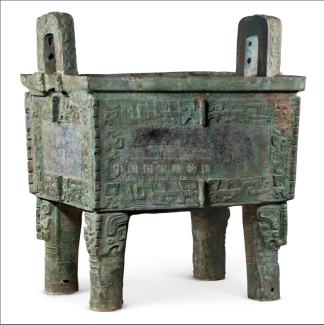
"HouMuWu" Bronze Ding
Late Shang Dynasty, circa 14th–11th century BCE Height: 133 cm, Length: 112 cm, Width: 79.2 cm Unearthed in 1939 at Wuguan Village, AnyangCity, Henan Province The "HouMuWu" Bronze Ding (formerly known as the "Si Mu Wu Ding") is monumental in scale, solemn, and imposing. Weighing 832.84 kilograms, it is the heaviest bronze vessel known from ancient China. Cast on the inner wall of the vessel is the inscription "HouMuWu," which is the posthumous temple name of the Shang k
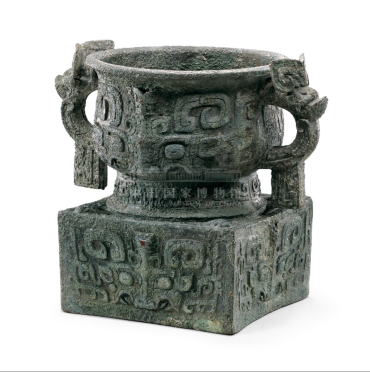
"Li" Bronze Gui
Western Zhou Dynasty, reign of King Wu Height: 28 cm, Mouth diameter: 22 cm, Square base: 20.2 cm by 20.2 cm Unearthed in 1976 at Lingkou, Lintong, Shaanxi Province The vessel has a flared mouth, paired animal-head handles with pendants, a rounded belly, and a ring foot connected to a cast square base. Both the vessel body and the base are decorated with taotie motifs, while cicada patterns adorn the four corners of the base. Bronze vessels with square bases of this type first appeared in the early Wester
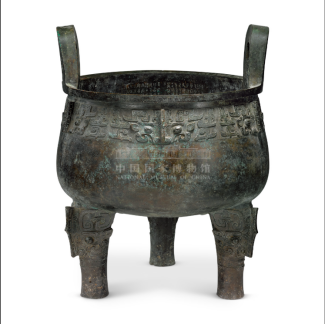
"Yu" Bronze Ding
Reign of King Kang of Zhou Overall height: 101.9 cm, Mouth diameter: 77.8 cm, Weight: 153.5 kg Unearthed during the Daoguang reign of the Qing Dynasty at Li Village, Mei County, Shaanxi Province The walls of the "Yu" Bronze Ding are relatively thick. The belly is broad horizontally, with sloping walls that flare outward, and a gentle curvature near the lower exterior of the legs, forming a drooping-belly profile. It is a typical example of large and medium-sized bronze ding vessels from the earl
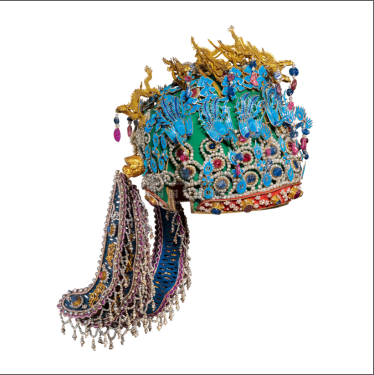
Phoenix Coronet for Empress Xiaoduan
Wanli reign of the Ming Dynasty (1573–1620) Overall height: 48.5 cm; Coronet height: 27 cm; Diameter: 23.7 cm; Weight: 2,320 g Unearthed in 1957 from the Ming Dingling Mausoleum in Beijing This phoenix coronet, worn by Empress Xiaoduan, was made with a lacquered bamboo framework forming the base and silk fabric as the outer covering. The front is adorned with nine golden dragons, each holding a pearl drop in its mouth. Beneath them are eight gold phoenixes decorated with kingfisher feathers, while t
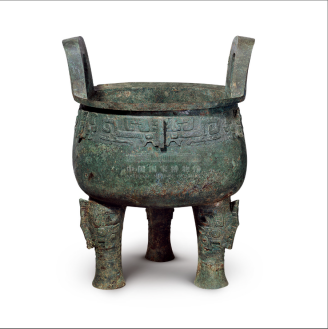
"Zilong" Bronze Ding
Late Shang Dynasty Overall height: 103 cm; Handle height: 22 cm; Belly height: 43 cm; Leg height: 36.5 cm; Mouth diameter: 80 cm Reportedly unearthed in Hui County, Henan Province, in the 1920s The Zilong Ding takes its name from the inscription "Zilong" cast near the rim on the inner wall of the vessel. Majestic in form, it is the largest round ding from the Shang Dynasty and is finely cast, representing a classic masterpiece of ancient Chinese bronze-casting technology. According to accounts,
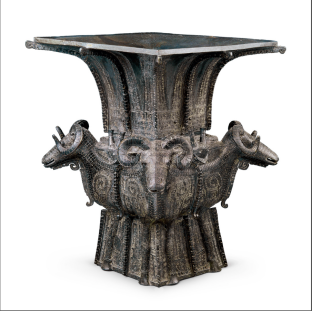
SquareVessel with Four Rams
Shang Dynasty Maximum diameter at mouth: 44.4 cm; Height: 58.6 cm; Weight: 34.6 kg Unearthed in 1938 in Ningxiang, Hunan Province Among extant Shang-Dynasty bronze square zun vessels, the Square Vessel with Four Rams is the largest. Bold and extraordinary in form, its shoulders, belly, and feet are ingeniously integrated into four rams with curled horns, each occupying a corner. The vessel combines high- and low-relief decorative techniques, seamlessly uniting the four rams with the vessel's body and tran
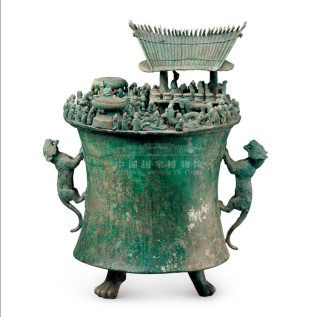
Bronze Cowrie Container with Sacrificial Ceremony Scene
Western Han Dynasty Overall height: 51 cm; Lid diameter: 32 cm; Base diameter: 29.7 cm Unearthed between 1955 and 1960 at Shizhaishan, Jinning, Yunnan Province When excavated, this vessel contained more than 300 cowries. Cast on it are 127 three-dimensional human figures in the round (incomplete figures not included), arranged around activities taking place on stilted buildings. The scene depicts the ceremonial proceedings of curse-making and oath-taking, including sacrificial killings conducted by the Ki
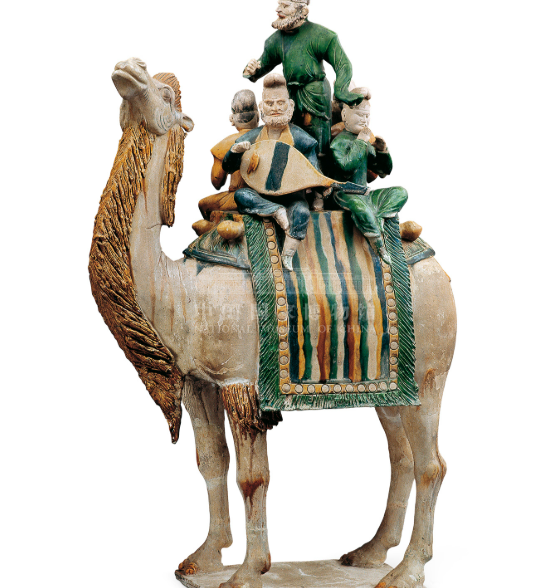
Polychrome Glazed Tomb Figurine of a Troupe of Musicians on a Camel
Tang Dynasty Camel head height: 58.4 cm, Length from head to tail: 43.4 cm, Dancer height: 25.1 cm Unearthed in 1957 from the tomb of Xianyu Tinghui, Xi'an, Shaanxi Province The Camel stands tall with its head held high, carrying five adult men ofHan Chinese and Central Asian ethnicities. The central figure, a bearded Central Asian man, moves gracefully to the rhythm, while the remaining four sit around him playing music. Of the instruments once held, only a pipa remains intact. Research suggests that one
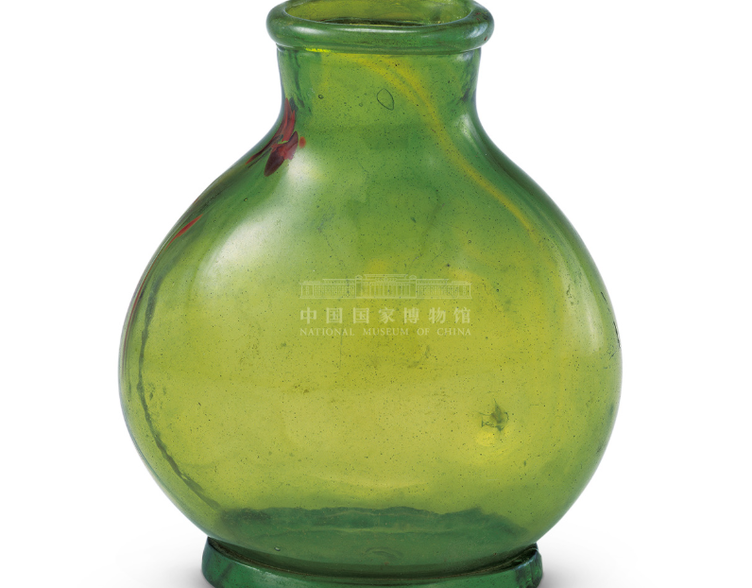
Oval Green Glass Bottle
Sui Dynasty Height: 12.5 cm Unearthed in 1957 from the tomb of Li Jingxun, Xi'an, Shaanxi Province Both the mouth and the cross-section of the body of this glass bottle are oval in shape. It was made using a blowing technique, with extremely thin walls that are crystal-clear and jade-like. While its form follows traditional Chinese shapes, analysis shows that its material is high-lead glass, indicating that it was manufactured in China. A total of 24 glass objects were excavated from the tomb of Li Jingxu
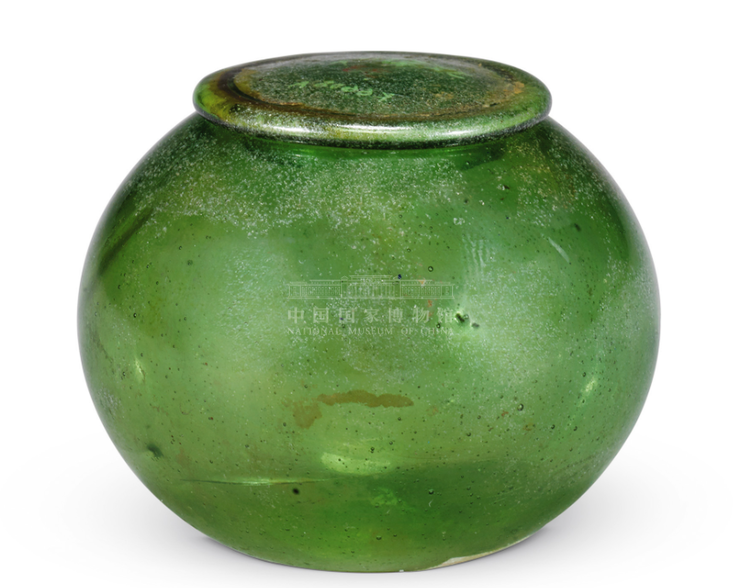
Green Glass Covered Jar
Sui Dynasty Height: 4.3 cm, Mouth diameter: 2.8 cm Unearthed in 1957 from the tomb of Li Jingxun, western suburbs of Xi'an, Shaanxi Province This jar is flattened and rounded in form, with a bulging belly and a constricted neck, and is fitted with a matching, flattened, round lid featuring an inner tongue-and-groove structure. The vessel walls are extremely thin, and the entire jar is transparent green in color, crystal-clear and jade-like, with an elegant form. It was used by aristocrats for storing spic